The media’s portrayal of public relations

Courtesy of Career Girl Daily
As almost every 20-something women, I have seen my fair share of Sex and the City. The show depicts four single women and their endeavors with their sexuality in New York City. One of the characters comes to mind when I think about public relations: Samantha Jones. Jones is a successful public relations professional who heads her own firm and can afford a $7,000-a-month apartment. She is always wearing designer brands, traveling to expensive destinations and planning extravagant events.
When first watching the show as a teenager, I aspired to experience a life like Samantha Jones: a strong, independent public relations professional who makes a lot of money. However, after working for a few months in the industry, it is definitely not as glamorous as Jones portrays in Sex and the City. The desire to be like Jones has lead to a phrase being coined: “The Samantha Jones Syndrome.” This “syndrome” describes the mindset young public relations professionals have when entering the industry. They believe that their career is all glamour, parties and money. But when these professionals experience what it actually is, long hours, stress and hard work, they become disheartened and feel misled.
This is how the media tends to portray the public relations field. Whether it consists of celebrity interaction, wealth or confrontation, it is not accurate to what the industry actually is. Here are a few more instances of inaccurate portrayals of public relations in the media:
Princess Carolyn - Bojack Horseman
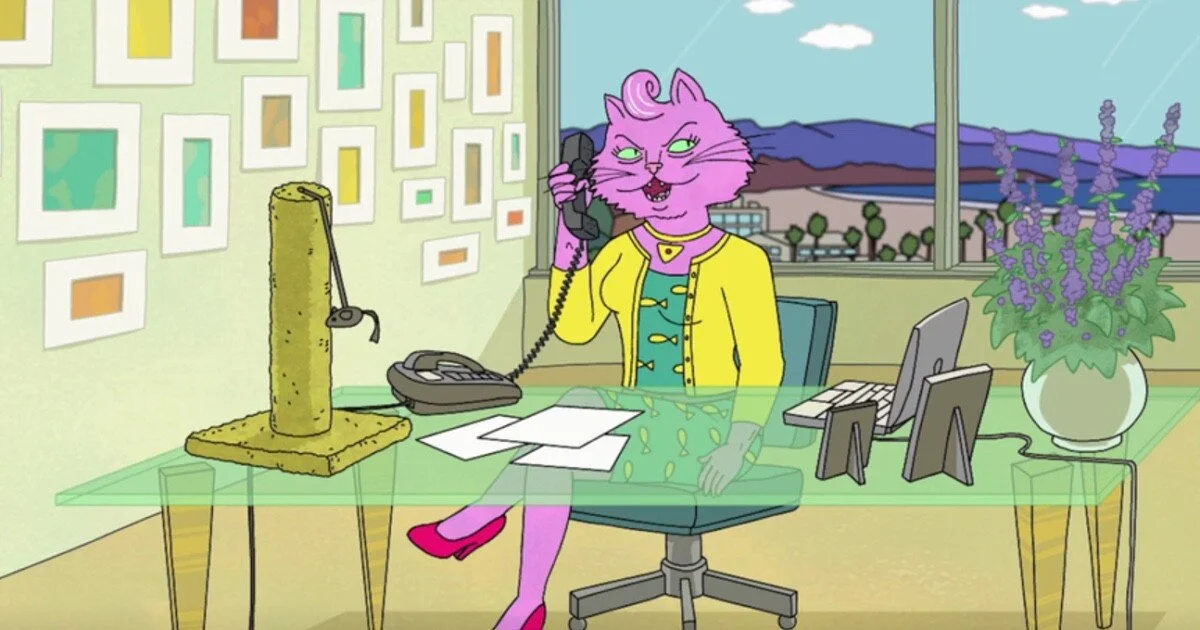
Courtesy of Bojack Horseman
Although Bojack Horseman is an animated show, it aims to depict deep character development and raw reality of life. The show is based around a once-famous, alcoholic TV actor, Bojack Horseman, who struggles with trying to reinvent his past fame. Princess Carolyn is his feisty and hard-working public relations representative who constantly has to make sure Bojack does not ruin his image.
As I said previously, even though this show is a cartoon, it shows a raw take on the reality of life. Princess Carolyn is constantly working, which makes her miss out on marriage and family. She also is depicted as ruthless public relations executive, where she will do anything to have the upper-hand in the industry, no matter how morally questionable. In one example, Princess Carolyn only attends a funeral to meet potential clients and convince them to work with her.
Personally, out of all the depictions of public relations professionals, this one is the most authentic. She is seen as a driven career-woman, but it depicts her struggle with balancing her personal life and professional life. It also shows the amount of work that some professionals may experience and the result of constant stress and work.

Courtesy of Flack
Robyn - Flack
In the television show “Flack” Robyn is an American public relations professional who works for a competitive public relations firm in London. She is depicted as the anti-hero, in which she makes extremely questionable decisions in order to preserve or promote her clients image. For example, she facilitates a breast cancer scare for a TV chef’s wife so he can be seen as sympathetic and caring.
This depiction of a public relations professional makes it seem that all professionals in the industry are cutthroat, and will do anything to preserve their clients image, in order to protect their career. A portrayal like Robyn is one of the reasons why public relations professionals may have a negative connotation. It can be a harmful representation to young professionals who hope to have a career in the industry. I do not doubt that there are those who are just as ruthless as Robyn in the public relations field, but to provide a generalization like this is not accurate.
Emily - Emily in Paris

Courtesy of NPR
Quite possibly the most unrealistic depiction of public relations is the Netflix show, Emily in Paris. In this show, Emily is an American who moves to Paris after receiving a job opportunity at a French marketing firm. She is constantly belittled by her French colleagues for not speaking French and her American behavior. However, she suddenly becomes Instagram famous for her portrayal of life in Paris on the platform. This makes her become famous and more respected at her marketing firm, and she (of course) falls in love in the end.
I say this is the most inaccurate depiction, because it shows the glamour of living in Paris while working at a marketing firm. To add in some character development, Emily is not respected at her company until she becomes famous. Though they represent the non-glamourous part of being the new professional at a firm, it inaccurately shows that you can just be successful overnight and gain the respect of everyone around you. It is a toxic portrayal because it shows young people that you do not have to do anything to earn the respect of your colleagues except somehow become Instagram famous.
This show earned a lot of backlash, not just because of the unrealistic portrayal of this career, but about Emily herself. Her character was criticized for the privilege she flaunted when arriving at her new job, where she did not desire to work with her colleagues. She also relied heavily on her Instagram presence to feel that she had an identity in Paris, but also in her life.
Though these portrayals may be accurate or inaccurate, the only way to determine how the industry works is through experience. These characters may represent some pieces of reality as a public relations professional, but overall, they can be grossly misleading to a person aspiring to work in the industry.